

The Canadian Dental Care Plan Is Working — Survey Data and New Research Agree
On October 29, 2026, the Auditor General released a new report that found the Canadian Dental Care Plan (CDCP) made access to dental care more affordable.
This promising finding aligns with the National Institute on Ageing’s (NIA) Ageing in Canada Survey and new research from the University of Ottawa.
The CDCP is a federal program that helps pay for dental care for Canadians with family income under $90,000 and no private dental insurance. Applications opened first for those aged 87 and older in December 2023, then expanded sequentially to those aged 65-86 by early 2024, with care beginning in May 2024. Children under 18 and adults with a Disability Tax Credit certificate could apply in June 2024, and all remaining adults aged 18-64 could apply by May 2025. By March 2026, about 6.9 million people had enrolled, out of roughly 10.5 million estimated to be eligible, and 61% of members had used their benefits (Auditor General of Canada, 2026).
Between the 2024 and 2025 NIA surveys, nearly a third fewer adults aged 50 and older went without dental care
NIA tracks poverty levels annually in the Ageing in Canada Survey with the Material Deprivation Index (MDI), which asks whether people can afford 11 basic items. One of these items asks whether people are able to get regular dental care, including teeth cleaning and fillings. Those who cannot afford those expenditures are considered to be experiencing dental care deprivation.
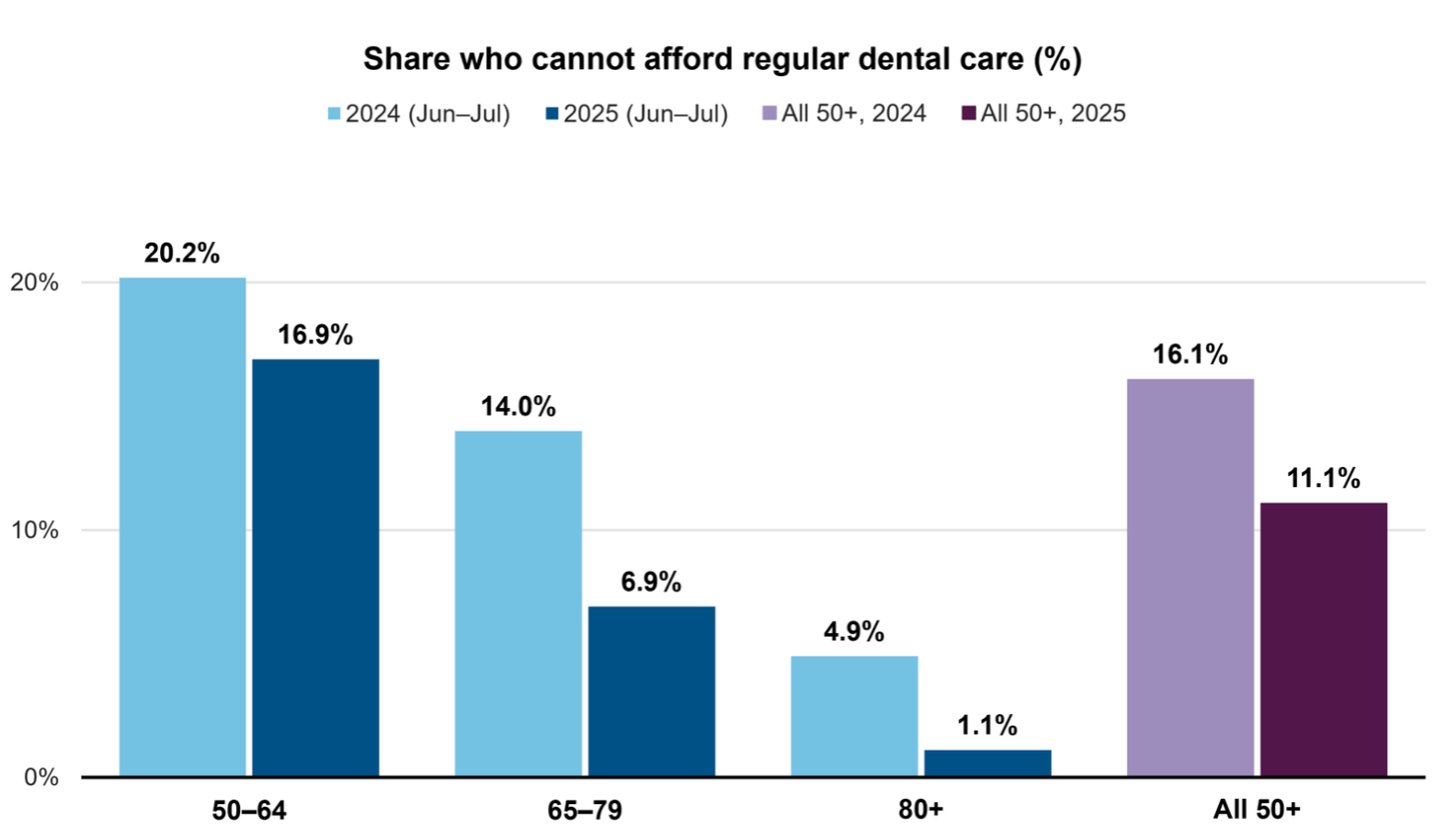
According to NIA’s Ageing in Canada Survey, the share of adults aged 50 and older who could not afford regular dental care fell from 16.1% in 2024 to 11.1% in 2025. The 2024 survey was carried out only weeks after care began, so it largely reflects the situation before the CDCP had any effect. When broken down by age cohorts, the steepest drops were among those aged 80+ (falling from 4.9% to 1.1%) and those aged 65-79 (falling from 14.0% to 6.9%). Conversely, among those aged 50-64, many of whom only became eligible for the CDCP weeks before the 2025 survey was conducted, dental deprivation fell from 20.2% to 16.9%.
Figure 1. Dental care deprivation by age group and for all adults 50+, 2024 and 2025.
Source: NIA Ageing in Canada Survey, 2024 and 2025.
This pattern fits what we would expect if the CDCP were working, and new evidence confirms the trend.
New research links the drop directly to the CDCP
A new working paper by Dr. Geranda Notten at the University of Ottawa tests whether the CDCP caused this drop. Because the CDCP opened to different groups at different times, Notten was able to compare older adults aged 65 and older, who could use the CDCP from 2024, with working-age adults without children, who mostly could not access the program until 2025. Notten uses the same MDI as NIA, and Food Banks Canada survey data from two different periods: spring 2023, which was before older adults could enroll in the program, and early 2025, which was after older adults could enroll.
Notten also accounted for differences in who answered the surveys each year, such as income and education. Notten’s main finding: the CDCP cut the share of older adults (aged 65 and older) who could not afford regular dental care by 8.7 percentage points. Notten’s model estimates that, without the CDCP, the 2025 rate would have been approximately 19%, rather than the observed 10.3%.
Notten estimates that about 694,000 more older adults can now afford regular dental care.
Figure 2. Dental care deprivation among adults aged 65+: observed rates and the model-estimated 2025 rate without the CDCP.
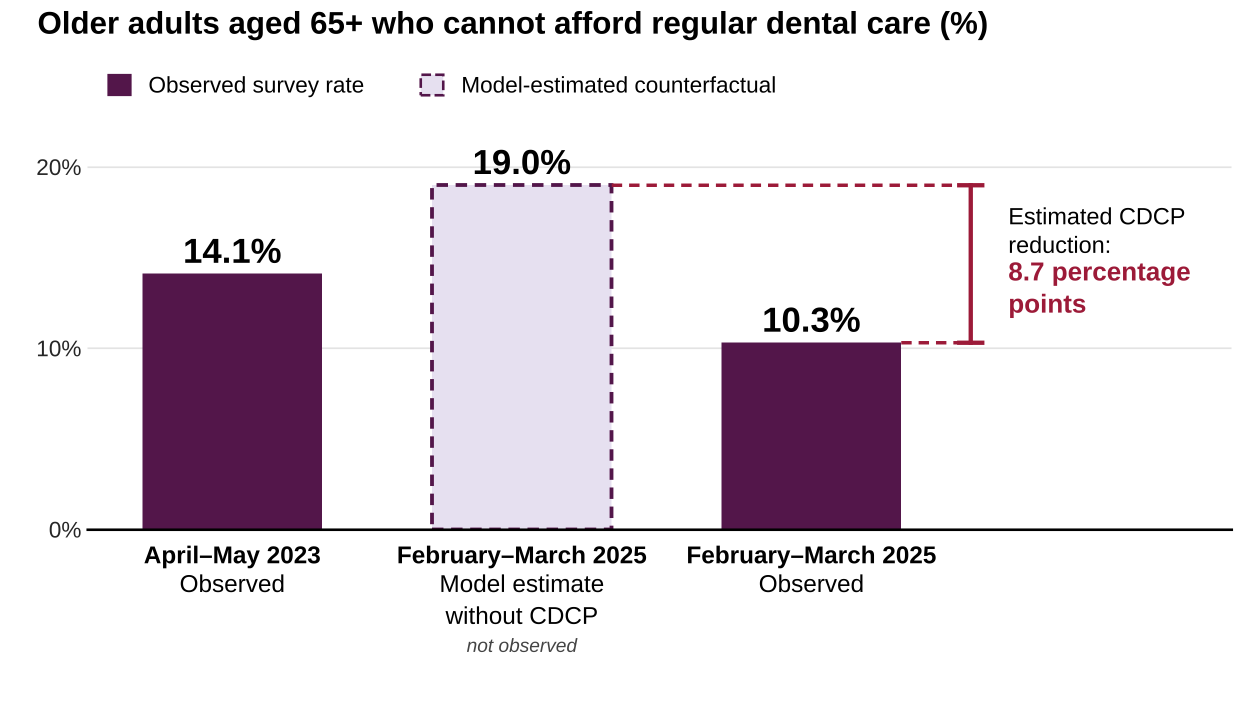
Source: Notten (2026). The estimated bar is a model-based counterfactual, not an observed rate: it adds Notten’s estimated CDCP reduction of 8.7 percentage points to the observed 2025 rate.
The effect was also biggest where it should be. Among older adults with incomes under $100,000, who are most likely to qualify for the CDCP, the drop was 11 percentage points. Among higher-income older adults, who mostly do not qualify, there was no meaningful change. Figure 3 shows both sources alongside the rollout. In both, the share of adults who could not afford dental care fell as the CDCP opened up.
Figure 3. Dental care deprivation over time and CDCP rollout milestones.
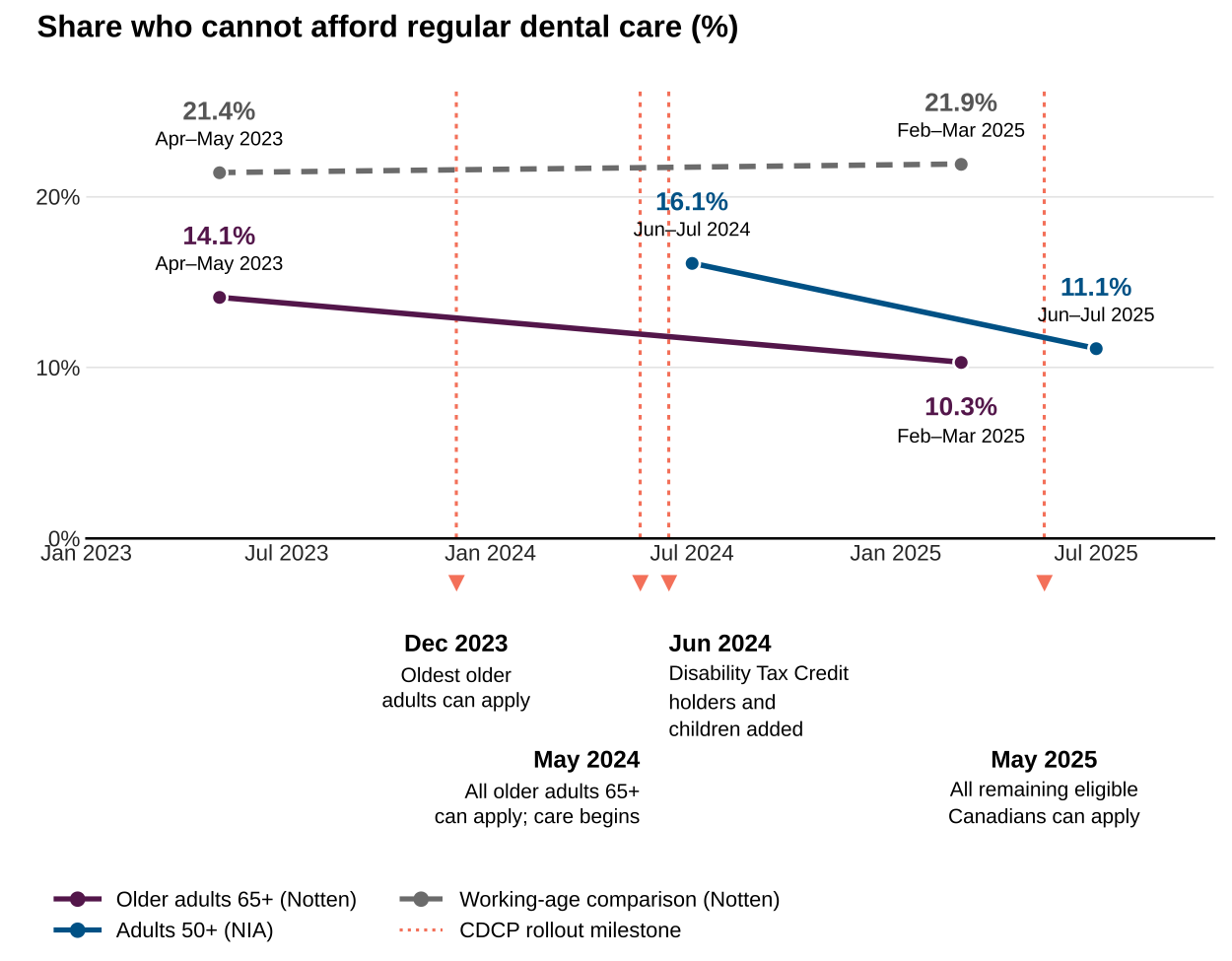
Sources: Notten (2026); NIA Ageing in Canada Survey. Points are placed at the middle of each survey’s fieldwork period. NIA’s survey covers adults 50+ and Notten’s covers adults 65+, so compare the trends, not the levels.
Dental care went against the trend
Notten’s data also show how unusual this change was. Between 2023 and 2025, older adults aged 65+ found eight of the 11 MDI items harder to afford. The share unable to cover a $500 surprise expense rose from 8.1% to 13.4%. Dental care, the most common hardship for older adults in 2023, fell more than any other item. If older adults had simply become better off, other items would have improved too. Instead, dental care was one of the few items that improved, just as the CDCP was implemented.
Figure 4. Material deprivation items among older adults aged 65+, 2023 and 2025.
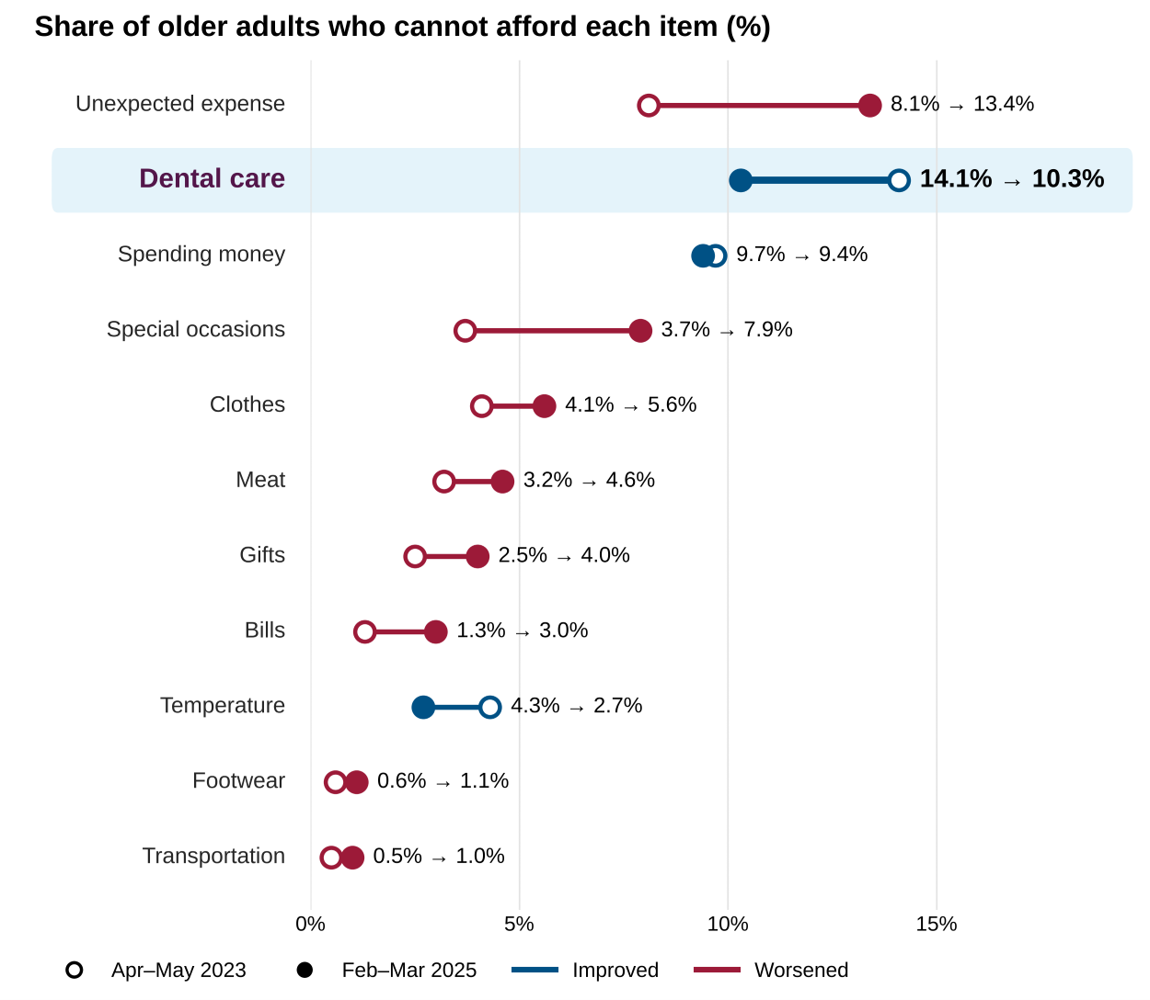
Source: Notten (2026), Table A1.
What it costs
The CDCP paid about $1.9 billion in dental claims for 1.8 million older adults (aged 65 and older) between May 2024 and June 2025, which works out to about $1,068 in claims per older adult who used the CDCP. But some of these older adults could already afford care, and were already paying for it themselves or through provincial programs, so not all of this spending closed a gap. Another way to look at the program cost is to count only the older adults who could not afford dental care before the CDCP and now can. Dividing the same $1.9 billion among these roughly 694,000 older adults, instead of all 1.8 million users, works out to about $2,776 in CDCP claims per older adult who gained affordable care. This is an upper-end figure, because it also counts spending on older adults who could already afford care.
Counting only the cost of care for those who gained access, Notten estimates the cost at between $1,068 and $2,137 per older adult, depending on how much more treatment they needed than other users. Notten calls these estimates illustrative and expects costs to fall, mainly because early claims include years of delayed treatment that older adults are now catching up on.
So far, however, costs have run above plan. The Auditor General of Canada found that benefit payments in the CDCP’s first two fiscal years exceeded the budget by about $1.1 billion, and federal actuarial forecasts show payments from 2026–27 to 2031–32 exceeding secured funding by $2.4 billion.
What this means for policy
The big picture is clear: the CDCP is working. Survey data and new research both show that fewer Canadians aged 50 and older are going without dental care since the CDCP rolled out, and that the biggest gains are among those the CDCP was designed to help. The Auditor General of Canada’s October 2026 audit points the same way: members who used their benefits paid an average of $264 out of pocket for dental care in 2025, about half the $536 that the average Canadian household spent in 2023.
The findings also point to gaps in the CDCP. The $90,000 income limit is not indexed to inflation. Had it kept pace since 2022, it would be about $100,500 in 2026. That means that more households will lose eligibility over time. Other gaps include that people with private plans are excluded even when those plans cover less than the CDCP, and access to the CDCP depends on filing taxes and reapplying every year. The Auditor General of Canada also found that about 84% of members paid something out of pocket in 2025, through co-payments (the share of the cost members with family incomes of $70,000 or more must pay themselves) or because providers charged more than the CDCP’s set fees. Children in provincial and territorial care, such as foster care, still cannot be enrolled.
Finally, these results show why the way we measure progress matters. The Auditor General of Canada found that Health Canada lacks before-and-after data on members’ oral health, which limits its ability to show whether the CDCP is improving oral health over time. Because the CDCP covers a cost rather than giving recipients cash, income-based poverty measures would miss its impact. Measures that ask what people can actually afford, like the Material Deprivation Index, can show whether in-kind programs such as the CDCP are making a difference in people’s lives.